
Crypto markets operate 24/7, and even traditional futures markets can move rapidly when major macroeconomic news hits.
For active traders, the challenge is rarely finding a trade. Instead, it is consistently executing the same strategy across multiple accounts without introducing manual errors.
This is where automation tools such as trade copiers become valuable. Below, you’ll learn what a trade copier is, why cloud-based copying matters, and what to look for when trading futures in volatile market conditions.
Key Definitions
Table of Contents
Crypto refers to digital assets such as Bitcoin or Ethereum that are traded on exchanges.
Blockchain is the technology that records transactions in a transparent and difficult-to-alter ledger.
Futures trading uses contracts that track the price of an underlying asset, such as stock indices, commodities, or crypto futures. Futures can provide leverage and liquidity, but they also increase risk.
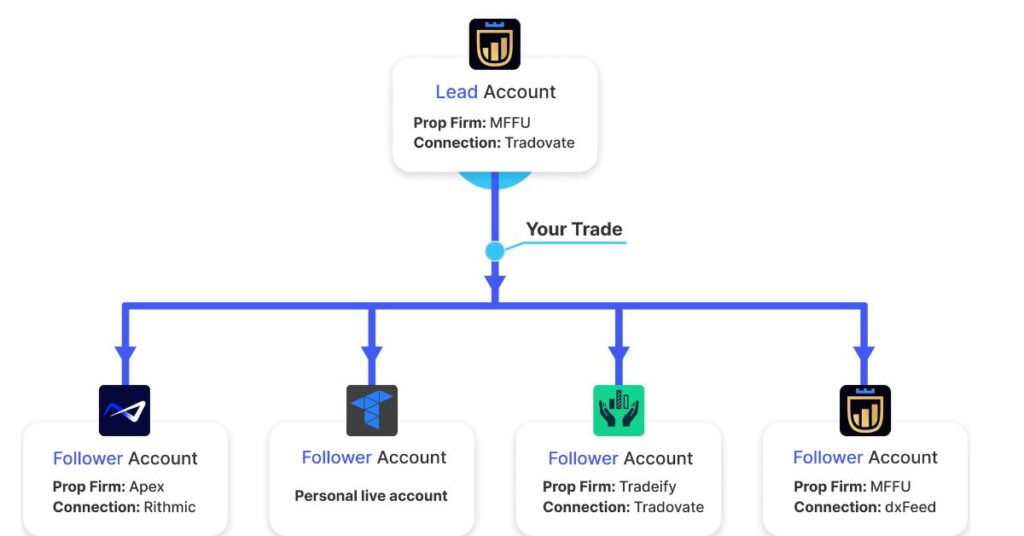
A trade copier is software that mirrors trades from a leader account to one or more follower accounts. You place a single order, and it is replicated across multiple destinations.
Why Traders Use a Trade Copier
Many traders do not operate with just one account. You may have a personal live account, one or more prop firm accounts, or separate accounts dedicated to different strategies.
Without a trade copier, you must manually enter orders multiple times and continuously verify position size, stop-loss settings, and trade direction. Over time, this friction often leads to inconsistent execution, especially during fast-moving market conditions.
A trade copier helps reduce manual errors, improve consistency, and save valuable time during volatile periods.
Why Cloud-Based Copying Matters
Older trade copiers often run on a local machine. If your computer freezes, your internet connection drops, or your platform crashes, the copying process can fail at exactly the wrong moment.
A cloud-based trade copier moves the copying process to a hosted environment built for uptime and speed. This can provide more reliable synchronization between accounts, reduce dependence on a single device, and make it easier to scale when adding more accounts.
Practical Features to Look For
Not all trade copiers are created equal. When comparing solutions, focus on features that support execution quality and risk management.
- Support for multiple brokers and platforms, allowing integration with your existing setup
- Low latency, since delays can affect fills in fast-moving markets
- Built-in risk controls such as maximum position sizing, daily loss limits, and trading lockouts
- Journaling and analytics tools that help compare performance across accounts and market conditions
A Simple Real-World Example
Imagine you trade a single futures strategy and want to run it across five accounts.
You enter a trade on your leader account with a clearly defined stop-loss and profit target. A trade copier mirrors that order to your follower accounts while applying any account-specific risk limits.
Instead of managing five separate executions, you manage one and keep your focus on the market.
Conclusion
Trade copiers are not about hands-free profits. They are about operational discipline: executing the same strategy across multiple accounts with fewer mistakes and greater control.
Traders exploring cloud-based copying for futures trading may consider solutions such as tradesyncer.com, which synchronizes strategies in real time across multiple accounts and brokers while providing risk controls and performance tracking.
Disclaimer: Trading involves risk. This article is intended for educational purposes only and does not constitute financial advice.


